

The successfully completed ESA project QUID-REGIS brings new insights about the dynamics of the interface between outer space and Earth.
1418

Scientists from the Institute of Experimental Physics SAS, in collaboration with the German Aerospace Center (DLR) and the Institute of Atmospheric Physics of the Czech Academy of Sciences, have successfully completed the two-year QUID-REGIS project (QUiet Ionospheric Disturbances REsearch based on Ground-based mesospheric and Ionospheric data with Swarm data). The project was funded by the European Space Agency (ESA), and its results provide a new perspective on the dynamics of the interface between outer space and Earth’s atmosphere.

“The aim of the project was to improve our understanding of the influence of atmospheric dynamics on the ionosphere, which plays a key role in the functioning of satellite navigation and radio communication. The project combined data from the Swarm satellite mission, as well as extensive databases of ground-based measurements, enabling a detailed analysis of processes that have so far been only little explored,” said Šimon Mackovjak from the Department of Space Physics at the Institute of Experimental Physics SAS, who led the Slovak participation in the project.

One of the outcomes of the research is a new scientific article published in the journal Earth and Space Science, which presents a unique dataset of the so-called quiet periods of space weather for the years 2000 to 2023. This dataset was created to simplify the analysis of the ionosphere, which remains highly variable even under minimal space weather influence due to processes occurring on Earth. The analysis showed that even during the longest identified quiet period, between August 18 and 26, 2019, the ionosphere was dynamic.

“Precisely during the ‘quietest’ periods of space weather, we can study the variability of the interface between outer space and the atmosphere caused by the Earth itself. This helps us understand how processes on Earth can influence even satellites in low Earth orbit,” said the space physicist.

The project results presented in another scientific article showed that intense events on Earth, such as the Kamchatka earthquake in 2025, can propagate into the uppermost layers of the atmosphere and affect ionospheric plasma even at distances exceeding 8,000 km from the source. This observation was made possible thanks to measurements over eastern Slovakia and the Czech Republic using a unique instrument capable of detecting Doppler shifts at altitudes of up to 340 km.

In addition to these scientific results, the QUID-REGIS project also strengthened international collaboration among the participating institutions, thereby enhancing the position of the Institute of Experimental Physics SAS in Košice on the map of space research in Europe.

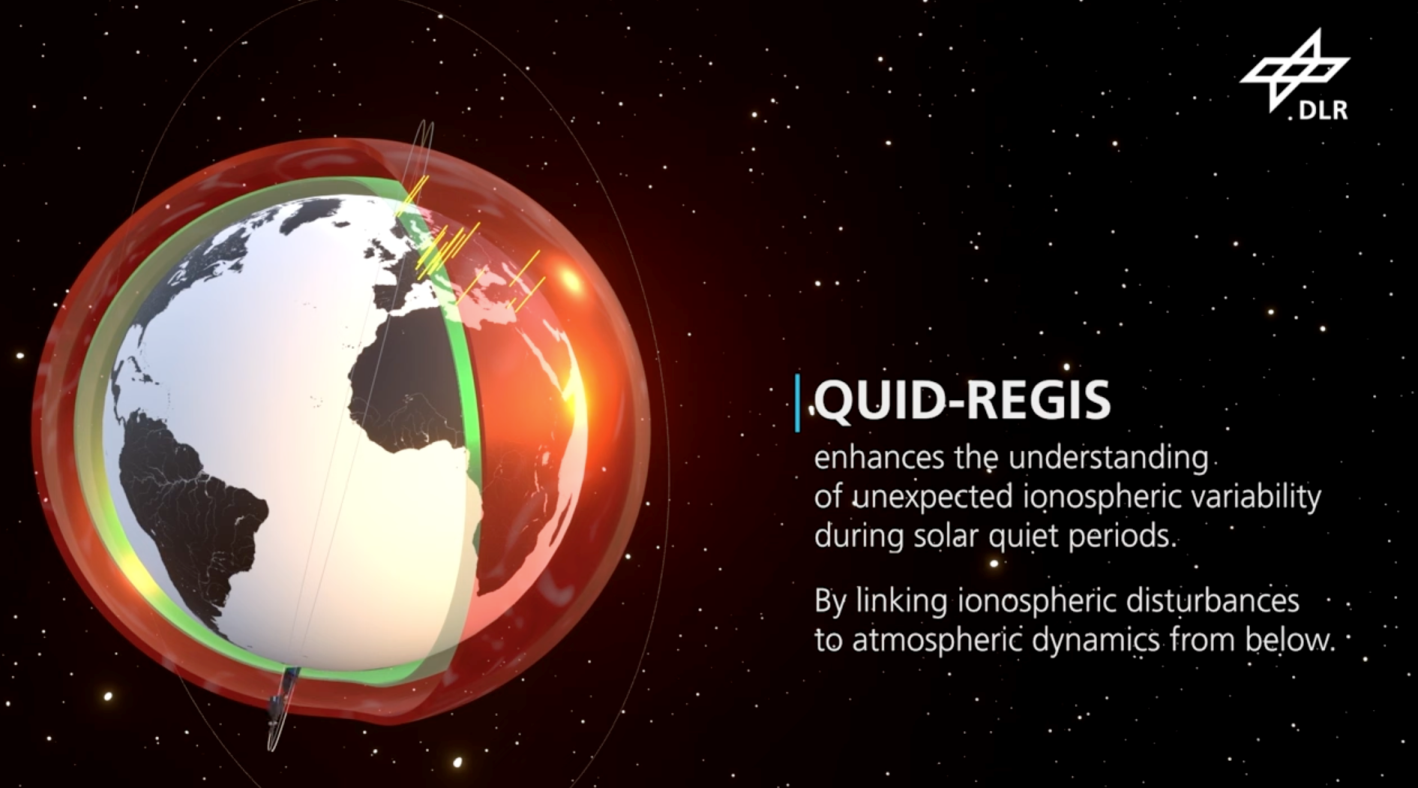
To better illustrate the studied topic, a video animation was created.