
 Contact
 Intranet
 SK
SK







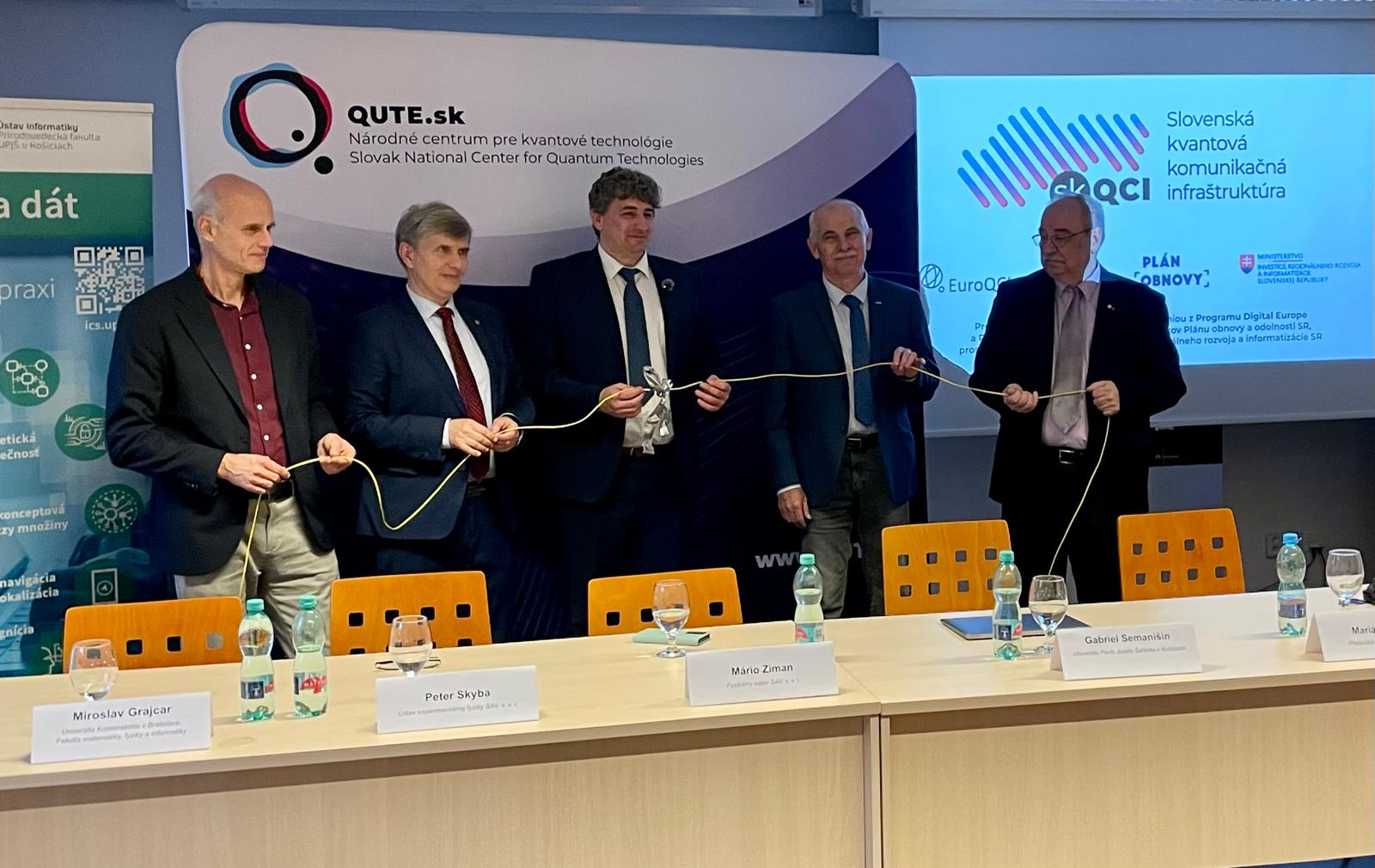
According to the center, the arrival of quantum technologies may bring societal phenomena similar to those we are currently experiencing with the rapid rise of artificial intelligence. In terms of security, one of the most significant changes will be the potential ability of quantum computers to break the cryptography currently in use, which protects banks, state institutions, hospitals, and critical infrastructure. Even though quantum computers currently do not exist, their arrival could trigger a major security shock that society needs to be prepared for.
“Security of quantum communication is based on fundamental physical principles that rule out any— even hypothetical —method of eavesdropping or breaking the communication. This means that Slovakia is launching a technology whose underlying principle cannot be broken by any amount of computational power,” said Mário Ziman, Director of the Institute of Physics of the Slovak Academy of Sciences (SAS).
The Slovak quantum network is being developed as part of the national skQCI project, which is part of the European EuroQCI initiative. Within this framework, the European Commission is funding the construction of the backbone network of the future quantum internet, which is expected to connect EU Member States by 2028. The development of quantum infrastructure is also supported by a wide platform of partners who have signed a memorandum on supporting the construction of quantum communication infrastructure in Slovakia. The signatories include universities, research institutions, public authorities, and technology partners. The memorandum establishes a framework for a coordinated approach to the deployment of quantum technologies, the interconnection of public institutions via secure quantum links, and the sharing of know-how across sectors.
The opening of the first link between Pavol Jozef Šafárik University (UPJŠ) and the University of Prešov (PU) is an outcome of this joint initiative. “This quantum link provides, among other things, an excellent opportunity for our faculty and university to enrich teaching with practical demonstrations and to carry out a new type of research in the fields of quantum computing and cybersecurity. This new stimulus has encouraged the faculty leadership’s intention to establish a new study programme focused on quantum technologies,” said Gabriel Semanišin, Vice-Dean for Development and Quality Management at the Faculty of Science of UPJŠ.
The Slovak consortium of the skQCI project, led by the Institute of Physics SAS in close cooperation with QUTE.sk, has been working on building this infrastructure for the second year. In addition to connecting Košice and Prešov, further connections are under preparation, including cross-border connections to Poland, Hungary, Austria, and the Czech Republic. While the link between Košice and Prešov is based on a commercial solution currently available on the market, Slovakia is not pursuing a strategy of exclusively purchasing existing commercial solutions. The primary goal of the skQCI project is not to bring technologies themselves to Slovakia, but to build expertise and know-how in the field of quantum security and supporting quantum technologies, such as single-photon detectors, QUTE.sk reported.
With this approach, Slovakia is joining the group of countries that are actively developing second-generation quantum technologies—those that will in the future enable not only secure communication but also the transmission of quantum information between quantum computers.
Source of text: teraz.sk