 Contact
 Intranet
 SK
SK







SPACE::LAB Summer School 2026: Artificial Intelligence heads into orbit
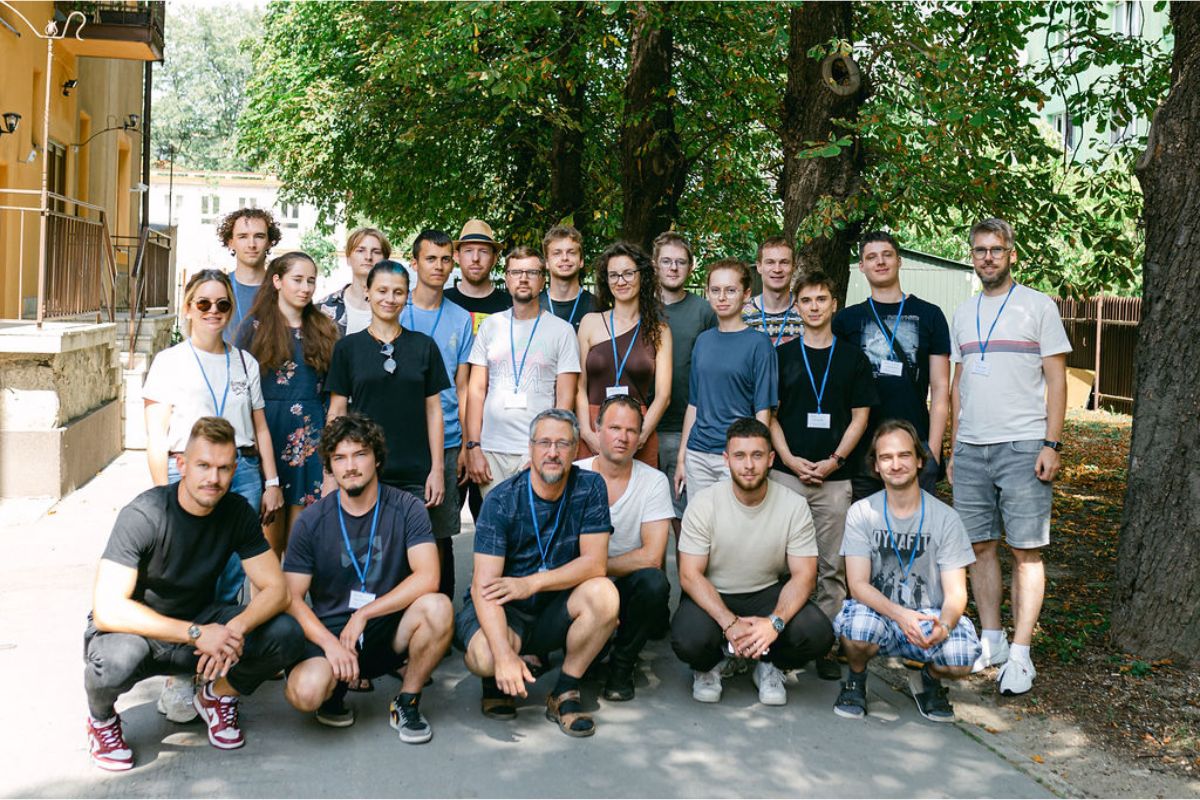
From August, 24 – 26 August 2026, the annual edition of the SPACE::LAB Summer School was held at the premises of the Institute of Experimental Physics SAS in Košice. This year’s theme, Towards Satellite Intelligence, focused on edge computing and the deployment of artificial intelligence directly onboard satellites. The event was attended by 22 students, young professionals, and lecturers.
“Modern scientific space missions can generate far more data than can be downloaded to Earth. As a result, the decision about what is actually worth transmitting is gradually being shifted directly onboard the satellite,” explains Šimon Mackovjak from the Department of Space Physics at the Institute of Experimental Physics SAS, who has been organizing the summer schools since 2019.
Therefore, the first day focused on the main components of a satellite and what it can expect to encounter in orbit — from orbit selection and mass and power budgets, through vacuum, radiation, and thermal cycling, to testing and qualification. Participants also visited the first space cleanroom in Slovakia, which was recently established at the Institute and features a thermal-vacuum chamber and a vibration system for qualification testing. An overview of current space observatories, such as JWST, Gaia, Euclid, and the upcoming Nancy Grace Roman Space Telescope, highlighted the other side of the same coin: the volume of data being generated today is growing faster than our ability to transmit and process it.
The second day focused on working with data and software. Participants learned how to access data from space missions through the HAPI interface, turn their own analysis into an installable Python package, and publish it. They were also introduced to how software is being developed today with the help of AI agents. A dedicated session focused on critical thinking: why a structured and technically convincing answer is not necessarily a correct one, and what remains the responsibility of humans when working with artificial intelligence. In the afternoon, participants used a simulator to try out the complete process of deploying a neural network on an FPGA — from model quantization to measuring the number of clock cycles that the computation would require on an actual chip. The network was tackling a real scientific task: segmenting coronal structures in images of the Sun.
On the final day, participants worked in teams on a joint project, giving them the opportunity to put the knowledge they had acquired into practice. “We wanted them to use their own numbers to verify that onboard intelligence is not about having the best model, but about knowing how much it costs and whether it fits within the satellite’s power budget,” adds Šimon Mackovjak.
The programme was prepared by lecturers from the Institute of Experimental Physics SAS, the Faculty of Mathematics, Physics and Informatics of Comenius University in Bratislava, the Faculty of Electrical Engineering and Informatics of the Technical University of Košice, and the private sector. Once again, the SPACE::LAB Summer School confirmed its role as a platform connecting space research, data science, and the development of young talent in Slovakia.
Text and photo: Šimon Mackovjak
Original text HERE