
 Contact
 Intranet
 SK
SK







Sloshing Ferrofluids Harness Vibration Energy, A New Spin on Powering Tomorrow’s Wearables and IoT
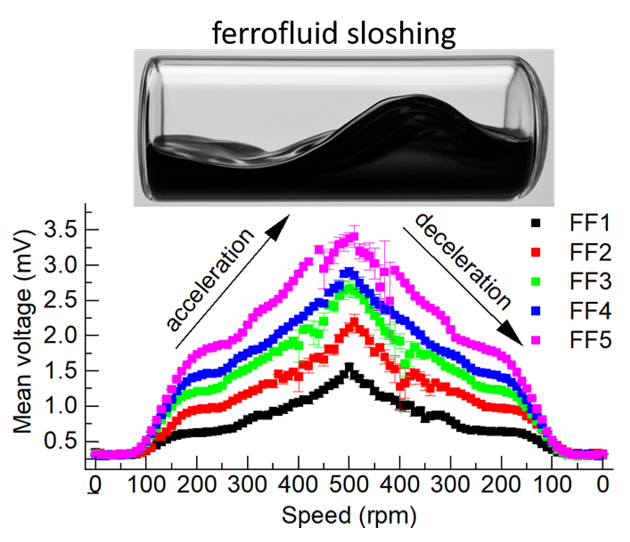
Modern devices, from fitness trackers and smart garments to Internet of Things (IoT) sensors, require compact and sustainable power sources. In new research published in Scientific Reports, scientists present an energy harvester based on a horizontally mounted vial half-filled with a biodegradable ferrofluid. When set into lateral motion, the ferrofluid sloshes in an external magnetic field, and a nearby coil captures the induced voltage. By systematically varying magnet configurations and nanoparticle concentrations, the researchers mapped how magnetic field geometry and ferrofluid magnetization influence energy output.
A team led by Dr. Michal Rajňák at the Institute of Experimental Physics SAS and the Technical University of Košice has demonstrated a novel approach to vibration energy harvesting using ferrofluids, liquids infused with magnetic nanoparticles, that could help power wearable electronics and distributed sensors.
Experiments using five ferrofluids with different magnetizations revealed clear trends. The harvested electrical power increases linearly with the ferrofluid’s saturation magnetization in the optimal configuration. The most effective setup uses a single permanent magnet attached to the vial’s side wall, producing a magnetic field perpendicular to both the oscillation axis and gravity. In this arrangement, the highest measured power reached approximately 232.6 nW for the most strongly magnetized fluid. Notably, in stronger magnetic fields the ferrofluid’s motion becomes hindered due to a magneto-viscous effect, reducing the induced voltage, a reminder that stronger fields do not always generate more power.
This lightweight and flexible energy-harvesting approach offers advantages over traditional electromagnetic harvesters, which typically rely on heavy moving magnets. The ferrofluids used here are prepared in biodegradable transformer oil, reducing environmental risk in case of leakage. Additionally, because the sloshing mechanism responds to mechanical excitations from multiple directions relative to the magnetic field, the method is well suited for irregular or multi-axis vibrations common in wearable devices and structural sensors.
As the lead author notes, “Our results show that a carefully arranged magnetic field combined with the right ferrofluid magnetization can convert everyday mechanical vibrations into electrical power. This opens a pathway toward truly self-powered devices.”
Although the present power levels remain in the nanowatt range, the authors envision future scaling, arrays of coils and ferrofluid modules could be combined to achieve higher outputs. Potential applications include self-powered wearable sensors requiring little or no battery capacity, embedded vibration sensors in industrial equipment that harvest their own power, and smart structural-health-monitoring systems where battery replacement is impractical.
About the Research
The study was funded by the Slovak Academy of Sciences, the Ministry of Education, and the Slovak Research and Development Agency.
Reference: Rajnak M., Kurimsky J., Paulovicova K., Tothova J., Kiraly J., Cimbala R. Vibration energy harvesting by ferrofluids in external magnetic fields. Scientific Reports, vol. 15, Article 26701 (2025).