
 Contact
 Intranet
 SK








Neutrinos are studied by Slovak physicists as well
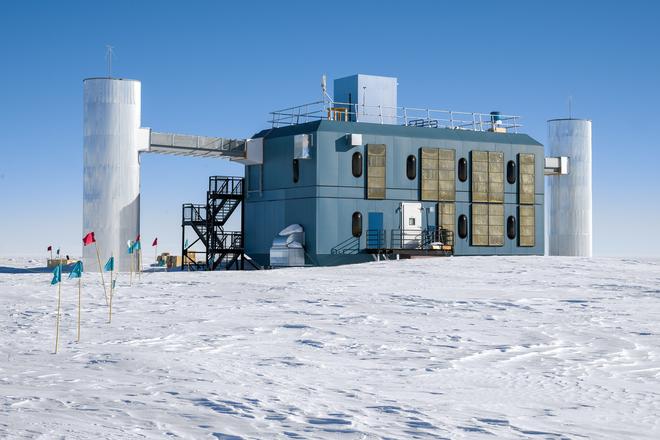
Belgian physicist Francis Halzen recently received the Nobel Prize for neutrino research and for his contribution to building the IceCube observatory at the South Pole.
Physicists in Slovakia are studying neutrinos as well. One of them is Blahoslav Pastirčák, researcher at the Institute of Experimental Physics SAS (Department of Cosmic Physics). He explains how calculations can help in their research. Research of the origin of neutrinos helps scientists to better understand the universe. It is assumed that high-energy neutrinos may originate, for example, in active galactic nuclei, supernova explosions, gamma-ray bursts, or collisions of neutron stars.
In the SME article, you will read:
- how and why neutrinos are studied
- what exactly the Belgian physicist received the Nobel Prize for
- why the calculations for the awarded research were also done in Slovakia
- how Slovak experimental physicists study the mysterious neutrinos
Neutrinos are studied underwater and in ice
Two institutions in Slovakia deal with high-energy neutrino physics. One is a group led by Fedor Šimkovic, winner of the ESET Science Award 2020, at the Faculty of Mathematics, Physics and Informatics of Comenius University in Bratislava. The other is the Blahoslav Pastirčák’s group at the Institute of Experimental Physics SAS in Košice. “Simulations are extremely important in this field because the signal we are looking for is exceptionally rare,” says Pastirčák. Neutrinos are often called “ghost particles” because they interact with matter only very rarely, which makes them extremely difficult to detect. There is a huge number of them in the universe, and they constantly pass through our bodies as well, with most of them passing through without any interaction. Nevertheless, we know relatively little about many of their properties and their cosmic origin. “They are exceptional for several reasons,” Pastirčák explains. “They have no electric charge, and their mass is very small. For a time it was thought to be zero, but in reality it is just very small. They pass through the environment, space, or matter practically without interaction.” According to Pastirčák, this is important because “they carry informationfrom great cosmic distances about what happened there, without that information being disturbed.”
Original text at SME.sk