 Contact
 Intranet
 SK
SK







Nobel Prize in Physics 2026: Neutrinos opened new window to the universe
The 2026 Nobel Prize in Physics was awarded to Francis Halzen for his decisive contribution to building the IceCube Observatory and for the discovery of high-energy neutrinos of astrophysical origin. The award recognizes the work of the entire neutrino astronomy community, of which Slovakia is also a part.
Why neutrinos are special
Neutrinos are one of the hardest particles in the universe to observe. They barely interact with matter, so they can travel enormous distances with practically no change in direction or energy. This property makes them unique messengers of information about the most energetic processes in the universe: objects and phenomena that we often cannot observe with classical astronomical methods. Unlike light, they can escape even from very dense regions where they are produced, bringing information directly from the places where particles are accelerated to extreme energies. Because they have no electric charge, magnetic fields do not deflect them, so they can point directly back to their cosmic source.
IceCube and a historic turning point
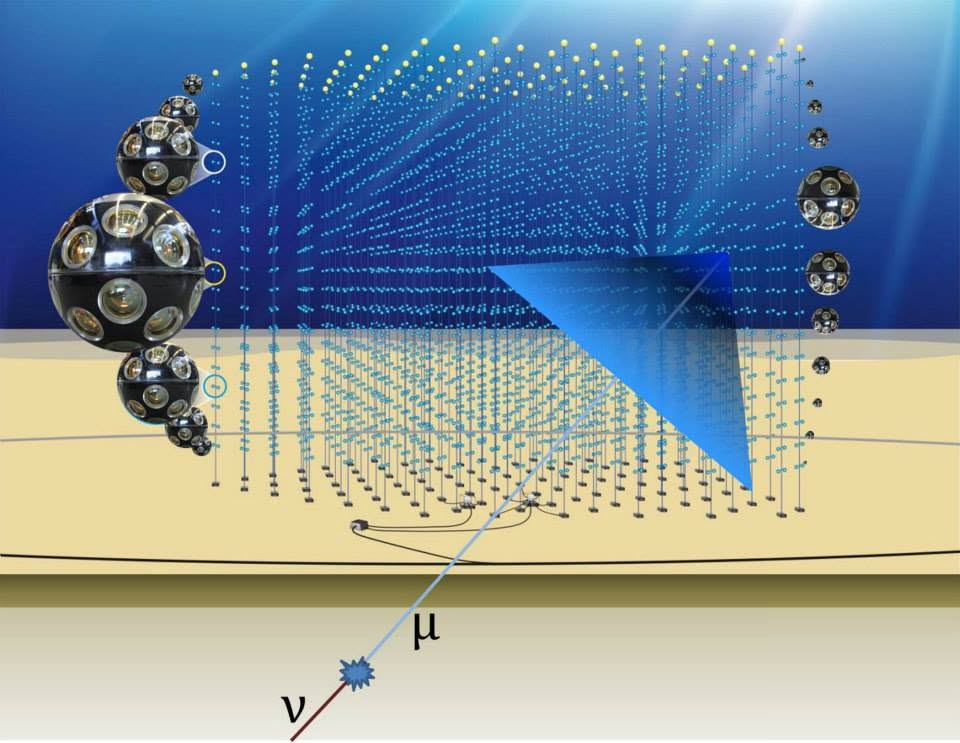
In the early 1960s, the idea emerged of using huge volumes of water as neutrino detectors. The principle is based on Cherenkov radiation, which tells that when a neutrino interacts with matter, it can produce a charged particle, such as a muon. If a muon moves through water or ice fast enough, it creates a characteristic flash of Cherenkov light. From the timing and direction of arrival of these photons, the particle’s path can be reconstructed, and from it the direction and energy of the original neutrino. The problem is the extremely low probability of a neutrino interaction, so the detector needs a volume on the order of a cubic kilometer. It must also be located deep underground, under ice, or under water to suppress the enormous background of cosmic radiation.
Francis Halzen was one of the key figures who pushed the idea of building a giant neutrino detector in Antarctic ice. IceCube covers one cubic kilometer and was completed in 2011. Thousands of optical sensors in it capture the faint flashes of Cherenkov radiation produced by neutrino interactions.
In 2013, IceCube recorded high-energy neutrino events with energies of approximately 1 PeV. The analysis showed that the observed signal could not be explained by neutrinos produced in Earth’s atmosphere alone. IceCube thus provided the first convincing evidence of high-energy neutrinos of astrophysical origin and opened an entirely new field of astronomy.
Our contribution: KM3NeT
At the Institute of Experimental Physics SAS, we work in this area as well. Colleagues from the Department of Cosmic Physics are active members of the KM3NeT collaboration. KM3NeT uses the same basic principle as IceCube, but instead of ice it uses seawater at a depth of several kilometers in the Mediterranean Sea. The experiment consists of many vertical detection strings, on which are mounted optical modules containing multiple photomultipliers. It has two detectors with different scientific focuses. Besides detecting high-energy cosmic neutrinos, it also studies neutrino oscillations and properties. The use of seawater and the location in the Mediterranean give KM3NeT a significant advantage in observing the southern sky, and especially the region of the Galactic Center. The IceCube and KM3NeT detectors thus observe different parts of the sky in a complementary way.
KM3NeT has already made a historic discovery. On February 13, 2023, it recorded the most energetic neutrino ever observed, with an energy of approximately 220 PeV. That energy is roughly a hundred times higher than that of the neutrinos that made up IceCube’s first significant astrophysical samples. Such a neutrino must be the result of an exceptionally energetic process in the universe. Its source is still unknown, and that is precisely one of the most interesting questions KM3NeT is addressing today.
What the award means
The Nobel Prize for Francis Halzen is not only recognition of a single experiment or a historical era, but also an acknowledgment of neutrino astronomy as a new method of exploring the universe. For our collaboration it has particular significance: it honors the path on which we are also walking. Our goal is to push the boundaries of neutrino astronomy even further and, using the most energetic neutrinos, to uncover the origin of cosmic rays and the most extreme particle accelerators in the universe.
Author: Blahoslav Pastirčák
Image: KM3NeT