
 Contact
 Intranet
 SK
SK







Chitosan- or Poly-L-lysine-modified nanoparticles for nucleic acid separation
The COVID-19 pandemic clearly demonstrated the importance of rapid and reliable diagnostic methods for detecting and monitoring infectious diseases. Nucleic acids, including RNA, are key biomarkers used in the detection, monitoring, and treatment of a wide range of diseases. However, the efficient isolation of nucleic acids from biological samples can be challenging, particularly when they are present at very low concentrations.
Researchers from our institute (I. Antal, A. Antošová, V. Závišová, M. Kubovčíková, A. Juríková, P. Pillárova, V. Jedinák, Z. Gažová, M. Koneracká) have investigated a promising approach based on magnetic nanoparticles for more efficient RNA isolation. Their findings have been published in the journal Next Materials.
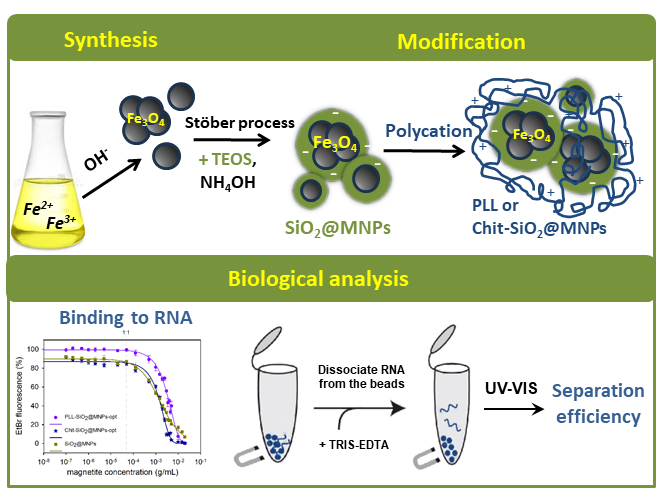
The research team focused on silica-coated magnetic nanoparticles (SiO2@MNPs) and investigated how their surface properties could be tailored to improve their interaction with nucleic acids. To achieve this, the researchers modified the silica-coated magnetic nanoparticle surfaces with two positively charged biopolymers, chitosan and poly-L-lysine.
The principle behind the approach is straightforward: nucleic acids carry a negative charge under the experimental conditions, while the polymer-modified SiO2@MNP surfaces carry a positive charge promoting their interaction with RNA. At the same time, the magnetic core enables rapid separation of the nanoparticles from the sample using an external magnetic field.
The researchers characterized the modified nanoparticles in terms of their size, shape, surface charge, magnetic properties, and other relevant properties. This allowed them to determine the conditions under which chitosan and poly-L-lysine formed an effective surface layer on the magnetic nanoparticles.
The most significant results were obtained from experiments evaluating the ability of the nanoparticles to separate RNA. The chitosan-modified nanoparticles extracted 58.64% of RNA, while the poly-L-lysine-modified nanoparticles extracted 33.99%. In comparison, the original SiO2@MNPs with a negatively charged surface extracted only 3.86% of RNA.
These results demonstrate that coating magnetic nanoparticles with a positively charged organic layer can substantially improve their ability to bind and separate RNA. The markedly higher extraction efficiency of chitosan-modified nanoparticles also indicates that the choice of surface polymer plays an important role in determining the material’s performance.
The findings provide a basis for the further development of surface-functionalized magnetic nanoparticles for nucleic acid separation. In the future, such materials could contribute to the development of rapid and efficient methods for isolating RNA from complex biological samples, with potential applications in biomedical research and diagnostic technologies.
Text, photo: M. Koneracká