
 Contact
 Intranet
 SK
SK







The secrets of black holes and the Higgs mass could be hidden in a 7-dimensional geometry
One of the greatest mysteries of modern physics, the “black hole information paradox,” might have finally found an elegant solution, and the answer could also reveal the origins of the mass of fundamental particles.
In the 1970s, Stephen Hawking demonstrated, through semi-classical calculations, that black holes are not truly black, but emit a weak radiation that causes them to gradually shrink until they disappear. This process, however, brings with it a massive problem: it seems to cause an irreversible loss of information, violating the unitarity principle of quantum mechanics. In other words, the laws of quantum physics state that information cannot be destroyed, but the evaporation of a black hole suggests otherwise.
Now, a new study published in the journal General Relativity and Gravitation, led by Richard Pinčák’s team, proposes an innovative solution based on the complex geometry of a space with extra dimensions.
A repulsive force to stop evaporation
In a paper published in General Relativity and Gravitation, the researchers explored the phenomenological consequences of a gravity theory, known as the Einstein-Cartan theory, formulated in 7 dimensions on a specific mathematical structure called a G2-manifold with torsion”. Unlike standard General Relativity, this theory allows spacetime not only to curve but also to “twist” (the so-called spacetime torsion).
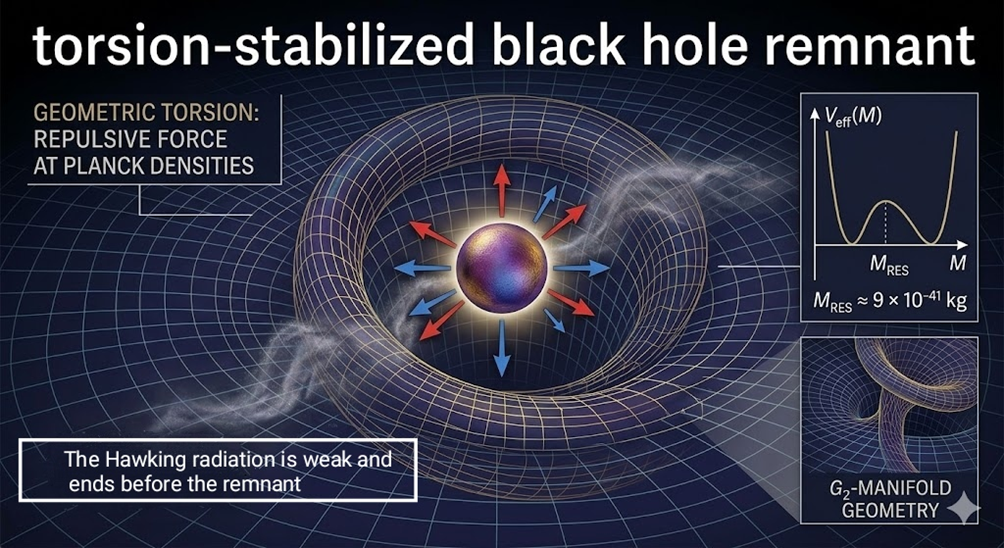
The key result of this model is fascinating: at extreme densities, typical of the Planck scale, this geometric torsion generates a repulsive force. This force counteracts gravitational collapse and dynamically halts the final stage of Hawking evaporation. As a result, the black hole does not vanish into nothingness, but leaves behind a stable “remnant”, whose predicted mass is approximately 9*10-41 kg.
Fig. 1. Torsion-stabilized black hole remnant. Schematic representation of a stable remnant in the 7-dimensional Einstein-Cartan theory on a G2-manifold with torsion. Geometric torsion produces a repulsive force (coloured arrows) at Planck densities, halting the final stage of Hawking evaporation and yielding a remnant of mass MRES≈9×10^-41 kg. The upper-right inset shows the effective potential Veff(M) with a minimum at the remnant mass. The lower-right inset illustrates the underlying G2-manifold geometry.
A 7-dimensional cosmic hard drive
If the black hole does not vanish, what happens to the information of all the matter that fell into it? The researchers propose that this stable remnant acts as a veritable memory archive. The structure of the remnant provides a concrete mechanism for storing information through the spectrum of its “quasi-normal modes”.
In practice, quantum information is encoded and trapped within the long-lived “vibrations” of the torsion field inside the remnant’s geometry. The team calculated that a remnant originating from a black hole with the mass of our Sun would be able to store the incredible amount of approximately 1.515*1077 qubits of information, exactly enough to resolve the paradox.
Killing two birds with one stone: the link to the Higgs boson
What makes this study particularly interesting is its profound connection to particle physics. The researchers demonstrated that the dimensional reduction (from 7 to 4 dimensions, our perceivable spacetime) of this geometry provides a natural origin for the electroweak scale ~246$ GeV). This scale is famous for being associated with the Higgs field, which gives mass to elementary particles.
In this theoretical framework, the vacuum expectation value (VEV) assumed by the torsion field is dynamically identified with the electroweak scale (about 246 GeV). In essence, the exact same geometric property that saves black holes from disappearing and preserves quantum information also offers a purely geometric explanation for the mass hierarchy problem in particle physics.
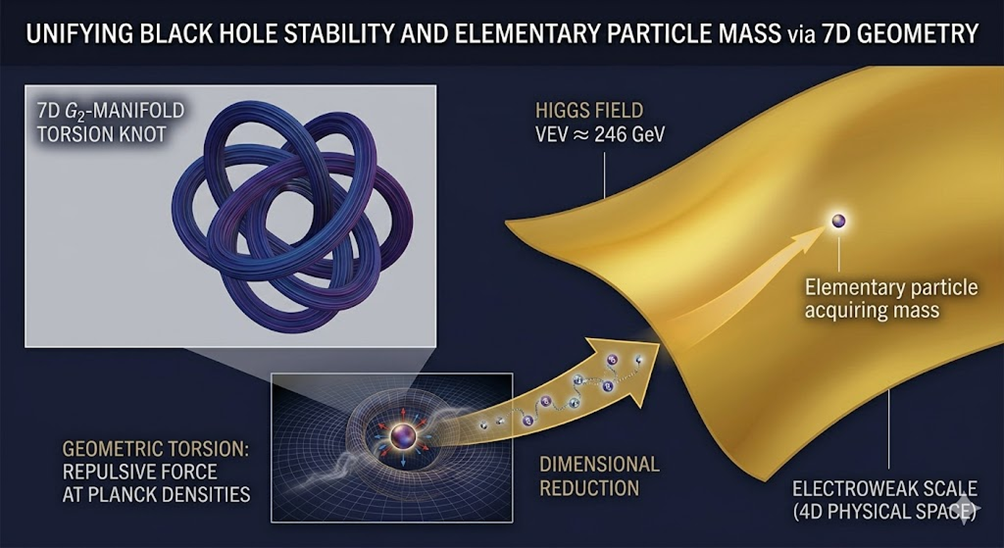
Fig. 2. Unifying black hole stability and elementary particle mass via 7D geometry. Schematic illustration of the framework presented in the 7-dimensional Einstein-Cartan theory on a G2-manifold with torsion. The left panel shows the 7D G2-manifold torsion knot. Geometric torsion generates a repulsive force at Planck densities (central inset), stabilizing a black hole remnant. Through dimensional reduction, the torsion vacuum expectation value is identified with the electroweak scale (≈246 GeV), naturally providing the Higgs field vacuum expectation value (VEV) and enabling elementary particles to acquire mass in 4D spacetime.
Beyond Colliders: A Testable Reality
Why don’t we have proof of these extra dimensions yet? The answer lies in the staggering energy scales involved. The researchers calculated that the particles associated with these dimensions (Kaluza-Klein excitations) have masses around 8.6*1015 GeV. This is seven orders of magnitude beyond the reach of the Large Hadron Collider (LHC), however, “invisible” to colliders does not mean “untestable.”
The theory is far from mere speculation because it is built on rigid geometric relations. If the model is correct, it makes specific, falsifiable predictions that can be hunted in the depths of the universe rather than in a laboratory. First, the stable black hole remnants (9*10-41 kg) predicted by the study could be a component of the mysterious Dark Matter. Detecting the gravitational signature of these “Planckian relics” would provide direct evidence for the theory. Furthermore, the information encoded in their “vibrations” (quasi-normal modes) offers a concrete mathematical framework that distinguishes this model from any other. Finally, the energy scales involved are typical of the very early universe, meaning that fingerprints of this 7-dimensional geometry could be hidden in the Cosmic Microwave Background or in primordial gravitational waves. By bridging the gap between the smallest scales of black holes and the vastness of the Higgs field, this research suggests that the information paradox might not require us to rewrite quantum mechanics. Instead, it invites us to embrace a deeper, 7-dimensional understanding of the very fabric of our reality.
Original publication:
Pinčák, R., Pigazzini, A., Pudlák, M. et al. Geometric origin of a stable black hole remnant from torsion in G-manifold geometry. Gen Relativ Gravit 58, 29 (2026). https://doi.org/10.1007/s10714-026-03528-z